Recent Movies
Showing posts with label art blog. Show all posts

Diamonds on the West Coast


Diamonds, like all other products, have been given to man to utilize and create jobs. If you are not into the romantic side of these blingy bits, consider that they are also very useful in industry because of their hardness and strength.

I found these lovely colourful diamond trawlers at Lambert's Bay, the best area for maritime diamond mining. This industry has only been commercially viable since the 1990's. Seabed crawlers can be remote controlled but mostly divers are needed. These divers, who can only work about six days per month because of our famous stormy waters, have to work in the cold of the Atlantic Ocean for up to 8 hours. When they spot diamond-bearing gravel on the seabed they direct the suction hoses towards it.

The gravel is then pumped onto sorting tables. When the boats return, the diamonds are taken ashore. What I loved about this scene was the hollow hoses floating on top the water, providing seating for hundreds of Cape Cormorants.
A Wish for the West Coast


When you have been away for a month, you will always look anew at your home turf. In Pretoria, I was charmed by the very positive outlook of people, the lovely climate, the lush parks and gardens. Something that is almost a phenomena is the ability of people up there to create! The markets, whether they are permanent, or held weekly or annually, just have so much that is beautiful and of a high quality.

Back home, I need to make a few fast sketches of some boats at Velddrif. There is a large hall, quite spacious at the little harbour and it is divided into market stalls, but the spark is not there and the visitors are scarce. Seeing that the West Coast is rather poor, it would have been lovely if the same quality home bakes and crafts that we see a few kilometers further in Paternoster could be offered here. This prettiest and most historical of harbours just do not see the visitors it could receive.

Lately, we have seen far too many impersonal malls appear on the West Coast, it would be lovely to see this great space at Velddrif become something much more craft-friendly.

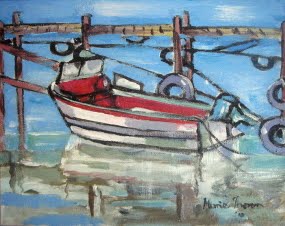
Here, once again, I have painted a colourful little boat in the mouth of the Berg River at Velddrif. As you can see it is not seriously realistic! I preferred to play around with some designs, like those repetitive rings!

Folks and Fish # 2


From my studio I can see Kabeljoubank where the snoek hang out to dry with Table Mountain in the distance. If the motorists racing past on the R27 will only spend 15 minutes to drive to this rocky outpost, they can observe a centuries old West Coast custom of drying salted fish in the open air and seabreeze.

My models are not the owners of the fish, but are helping to turn and guard them for a small daily fee. On my first visit two years ago they were timid in front of the camera and extremely shy of the easel and paints set-up. Now, for a small modelling fee, they hold out the snoek so I can observe the lovely pinks of the wet fish and the blue and turquoise colours when the sun reflects the oil in the fish.

The painting, I think, is my least favourite of the "Folks and Fish"set of four because of the bright sunlight and deep shadows. I much prefer the cloudy moods of the West Coast for my paintings. New readers can read more about snoek in two of my older posts: Snoek drying on the fence, and Smoorsnoek prepared in a country kitchen.

Folks and Fish # 1


This is the first painting of a set of four works, of which I have shown the preparatory sketches in the previous post. Working at them I am conscious of the poverty of the area and the plight of those brave souls, the sustenance fishermen, who face the sea day by day.

My model shows two of the four crayfish he is allowed to catch for his daily quota during the crayfish season. It will be safer for the men to catch the monthly allowance in one single day, and not face the sea so often, but unfortunately such a system will be difficult to control. (Crayfish can become very scarce and must be protected.)

Crayfish holes are marked by experienced fishermen, who will put on diving suits and retrieve their quota. Older people and non-swimmers can catch theirs by netting from the quay that conveniently projects into the sea like it does at Yzerfontein. Everybody keeps a measure handy as undersized specimens must be returned to the sea immediately.

We usually buy crayfish in Velddrif when they are in season and available, so I decided to use the harbour at Velddrif as a background for the painting. New visitors can read more about crayfish on the West Coast in my post: Crayfish Coast.

Post # 100!! Art Blogging is Tops!


This is my hundredth post. I have not completed a painting as I am working on a commission and the sketches took some planning. One of them will be finished for the next blog. They are all about the people of the West Coast and what they do. I think I will call the set:Folks and Fish

I love art blogging! Art blogging is Tops! In no other way would one be so committed to paint year in, year out and that without a sense of rushing. (One or two exhibitions a year make up for the rushing part!) My nicest surprises as a new art blogger were when I featured on other art or travel blogs.

  1. South African Blog of 2009 winner PORTFOLIO gave me a short feature in November: Marie Theron-Documenting the Real West Coast in Paint and Words .
  2. This was followed by another article on PORTFOLIO in December: 10 Questions for West Coast Artist Marie Theron .
  3. Here is an article Marie Theron-West Coast Artist which appeared on Bokkom.
  4. In the beginning of 2010 Katherine Tyrrell started 'The Art of The Landscape' and bloggers were challenged to analyse their own paintings. I liked the idea and wrote: The Wheatfield and Why it was Successful. Katherine, a top 5 blogger in the UK placed me in an article: Self-Critique Marie Theron.
  5. What a lovely surprise it was when 'Art with Liz' made special mention of my work on the West Coast in the post Bergriver, Velddrif.
  6. Friendly Liz visited me at home in April where we shared sherry and a fire and chatted up a storm. She wrote: Velddrif in April. I featured in many of the comments from her friends too! Bloggers are so kind!
  7. Paying my regular online visit to Postcards from the Hammer, Catherine Jeffrey's blog, I was very thrilled to find my name in the post Yonge Street Patterns 2, Toronto, Ontario.
My husband once teased that bloggers give each other a warm feeling! Exactly!

Bokkoms: Turning from Silver to Gold


As the little fish dry out they become thin, papery and have a rich golden hue. In my painting I show some people deftly gutting and skinning the fish. It is good to watch them for a while as you can then have a few bokkoms weighed out and clean them yourself at home. The meaty part is then cut into tiny strips. About these workers: no assembly line here as each worker makes him/herself comfortable on an upturned crate and sit either in the shade or in the sun. Later I strolled up and down the Berg River looking at every bird, boat, bend and island in the river, and still the lady in the yellowish t-shirt concentrated on her task, never moving, maybe because the knife was very sharp. "Her back!" I thought, and tried to paint the tension in those back muscles.

So how do we eat this delicacy? No doubt, the great cooks will invent some interesting pates for us, but here on the West Coast bokkoms are either eaten as a salty snack with ice cold bear or wine, or the other way, the high calorie way, which is how I and most people prefer it: Take home-baked oven-warm white bread, plaster it with real butter, add a good dollop of sweet apricot preserve and arrange the bokkoms on top. Pour a cup of the best coffee with it. Now I know how I am going to celebrate the completion of this week's post!

Into the New Year 2: The Wheatfield and Why it was Successful


I am still not posting but am reared to go full steam ahead after the 15th of January. Some of the more energetic members of the family are climbing Lion's Head at this very moment. I have done it a few times in the past....you do not have a straight climb but you circle around and around...yes 360 degrees of splendid views. Some I my new followers mentioned that they will visit the country during the soccer olympics. Make a note of climbing Lion's Head!


As far as NYR go, I have to learn more technical skills....like I really do not know how to show the blogs that I love to follow or how to insert a link! But to post this morning I have decided to look back to my most successful painting and analyse why it worked. I hope that some of this will be helpful to others too: My depiction of a Wheatfield in the Swartland outstripped all my other paintings in popularity on the blog, on Facebook and according to e-mails I received. Why did it work so well and what will help me in future when planning a work of art?

  1. Building up some anticipation. Looking back I can see that I was in quite a fix. It was stormy and rained a lot when we expected summer weather. I could not reach my wheatfield. So I kept referring in the social network to this golden field eluding me. I can now see that waiting for it was part of the allure of the painting when I eventually encountered sunny weather and could complete it.


  2. Yellow Colour Magic: Kandinsky, as he opened the way towards abstract painting, did a very good study of colour. He called light blue a receding colour and yellow an advancing colour. We also have science encyclopedias at home where yellow is named for its "shouting" properties, in other words yellow attracts attention and advances towards the viewer. Also remember Van Gogh's several sunflower paintings where the flowers and the background are in different hues of yellow. There are many colours with great qualities waiting to be used this year.


  3. Nostalgia: A wheatfield painting comes with the built-in emotions that relates to bread, frugality, survival, goodness and health. I was tearful myself when I received ALL the words of America the Beautiful in my comments! A record comment in length and if that kind lady will send me her address, I will mail her a print of the painting. As for the future, there are many topics which are bathed in tradition!


  4. Biblical Connotations: Wheat and bread has always played a soft role in religion. In the stories...Ruth and Boas...and in the time-honoured ceremonies. This year I will look for more scenes with universal appeal!


  5. Art Historical Connotations: Of course a wheatfield stands in the tradition of Constable, Van Gogh (who did several paintings of wheatfields, both happy with sunshine and bales of wheat as well as threatening with reapers and crows), Morisot, Monet and Van Ruysdael. There is also the modern earth art work by Agnes Denys near Manhatten. Look it up, it is a famous contemporary statement! There is a great upsurge in History of Art, I will use my art books and magazines this year!


  6. Composition: As was realised in the Renaissance curly lines and diagonals bring movement and agitation to a painting but calm horisontals leads to a comfortable state of mind in the spectator. In the market, many buyers of art would prefer this restfulness against a living room wall to encourage "winding down" or in a boardroom to sooth anxiety. The wheatfield I painted, answered this need of a pieceful, soothing piece. In the coming year, I will plan ahead the type of mood I want my compositions to generate.

I encourage all art bloggers out there to consider their best pieces of the last year and to ponder for a moment the elements that made the work a success!


Last Painting of the Year: The Outlook!


This alcove was spotted in Piketberg, shaded by a Victorian corrigated iron roof. The large sash windows have frames encrusted with dark "heritage green" paint, which in South Africa usually indicates a National Monument or very old building. The chairs and blackboard menu invite the passersby to rest and eat. Outside is the sunny sky of Piketberg and the road from the mountain sloping by.....


Here are my New Year's wishes to you: there are steps to take, and roads to cross, an uphill climb, a downhill slide, new doors to enter and new windows to open. As we wait with bated breath to enter the New Year, may the choices be many and varied and exciting!

Wishing you a Wonderful Christmas from the West Coast


Nowadays, when I take a walk through the fynbos, I notice that the West Coast fairies have been very busy decorating their Christmas trees! We normally call this bush the tortoise berry shrub. In spring the strong thorny plants are covered in pretty pink flowers. And then, in December a wonderful berry pops out of each flower. It goes through so many colour changes, starting with light beige, soft green, yellow, followed by the purples until it reaches the final bright red colour. Look at my painting and the photographs and you can see how closely it resembles a beautifully decorated tree in miniature!

I never knew that there were West Coast fairies, but now there is a wonderful book: "Fynbos Fairies" by the poet Antjie Krog and illustrator Fiona Moody, and they have captured our fascinating ethnical community of fairies. The synopsis on loot.co.za reads: "There is a fairy living around each species of Cape Fynbos ----they work and play, they tend the fynbos or make a mess. They laugh, they sleep, they dream - life's busy for your average fynbos fairy in the veld."

The bright red tortoise berries are beloved by fairies, children, tortoises and birds who all love the thirst-quencing astringent tasting little morsels. Mmm, what a neat idea: the baubles on the West Coast fairies' tree are edible! The botanical name of the berry bush: Nylandtia spinosa. The book was published by Umuzi . ISBN 978-1-4152-0022-3

Piketberg - A Mountain and a Church


I can only present you with a preparatory sketch today! This type of sketch is what usually lies underneath my proper painting.

Like many small towns here and everywhere else, Piketberg started with a church building. Towering above everything else is this very impressive Dutch Reformed Church with splendid gardens all around and the mountain behind. It is already two centuries old and was designed and built in Neo-Gothic style by Carl Otto Hagen and has now been declared a National Monument. I took so many photos of the building and gardens and will send some of them to the Piketberg website. (I will leave the link in a comment below when I have done it.)
The days are getting busy here...I have almost finished the painting of a West Coast plant that I will post on Christmas day, but for the rest everything is suspended and my personal paints and brushes will be packed away as I "renting" out my studio to my 5-year-old twin granddaughters for their crafting and painting in exchange for lots of hugs!

Before leaving my blog, you might also like to read the 10 Questions I answered for Portfolio Collections, a wonderful domain who had won the South African Blog of the Year Award 2009. Click on my portrait in the right-hand column.

Arriving in Piketberg


What more could a town ask for? Piketberg lies against a wonderful mountain and its streets are lined with enormous jakaranda and other types of trees! The mountain harbours two more towns on its opposite side, but long ago the Gonjemans tribe lived here, and many examples of San art can be found in the caves. Khoikhoi herdsmen also knew the place intimately and would hide russled cattle in the caves and valleys. It was decided in the 1670's to create a small military outpost known as a piquet (French) or picket (English), from there the Afrikaans name Piketberg.

A cannon placed on the mountain was used to warn surrounding farmers of trouble in the vicinity, or of ships arriving in Table Bay harbour to buy their products. It boomed happily when Queen Victoria had a birthday, and even more so when a telephone line was completed that linked the town with Cape Town. The cannon is filled up with concrete now, and kept in the schoolgrounds. You can just see the lovely old school at the end of the street.

Workers in the Vineyard


On a lovely early summer's day I take a drive to admire the farmlands between Malmesbury and Piketberg. The popular crops are wheat, vines, our local herbal Rooibos tea and proteas. It seems on the road that I'm on that most farms have opted for wheat and vines. The result is so pleasing to the eye and one is met by alternating patches of gold and green.

The workers in my painting are pruning the neat rows of vines. We sometimes complain that wine is expensive, but should consider for a moment all the labour and cost that is involved. The cuttings are grafted, cultivated, treated and dusted and then planted in ploughed and fertilised furrows. Take into account the trellising and pruning, protection against pests and diseases, irrigation, picking, sorting, distilling! What a process! The workers are usually part of the large farm "family" and will have homes, salaries, schooling and medical attention..........is wine really that expensive?

Sun and Shadow


I always find the best spots to paint at noon with the sun glaring down. The downside is that the contrasts are sharp. The advantage of this is that it provides me with an opportunity to study the features we need in our South African homes to provide shelter from the heat.
Driving along the highway to Malmesbury this cottage suddenly appearred 'in the middle of nowhere' near the main road. That it seems so solitary is an indication of the abundance of space we are used to in the West Coast region. The house was built in what we call Victorian style in our country, but whereas Victorians had to consider heating, architects here had to incorparate into their design our lenghthy summers and providing natural cooling. The most important feature these little homes had was the deep shady verandas. It kept the dining- and sitting room, which were always near the front, very cool and provided a lovely sheltered outside area to sit during the day. It provided symmetry and order to the design, and here the two large trees were used to provide a neat frame.
I noticed that the building now had a religious use, but my memories were stirred and I thought back to a time when a man would read his newspaper outside on the veranda while his wife sat there preparing vegetables. Besides a comfortable bench there would be an upright table which could be laid so that the family could enjoy their supper outside on hot summer nights. Yes, sitting down to dinner wherever you were, was a great South African tradition! How things have changed with the advent of television!

Cape Dutch Architecture


I spotted this building on a street corner in Malmesbury. This is one of the typical white Cape Dutch homes that is such a feast for the eye because of the clean symmetry. Of course this style originated in the Netherlands, but in a very different way and developed here over the years in our own gracefully unique style. In Dutch cities we can still see tall narrow buildings, several storeys high that are topped with gables. In South Africa with so much space available the building style transformed itself into spacious floor plans and usually a single storey. Because the rules of symmetry were followed, the homes were either long or in an H or a T shape.


The burghers had tiles for roofing at first, but those early tiles cracked in the harsh climate. Reeds was the best local material available and the roofs needed to be high-pitched to prevent water from settling on the roof and creating rot. Soon the white gables and high thatched roofs became characteristic of the Cape Dutch style. I mentioned in an earlier blog that the large gable also freed the front door from burning thatch blocking the entrance in the event of a fire.


High ceilings and thick walls lead to cool interiours. Flagstones that came over to the Cape as ships' ballast were used for the floors and sometimes highly polished. Windows are always higher than their width, and rhythmically placed.Today many of these homes are beautifully restored, authentically furnished and lived in or preserved as national monuments and museums.

Neo-Baroque in the Swartland


I have sketched town halls and churches in Rotring pen, but painting the all-white very complicated Swartland Dutch Reformed Church building in its entirety was too ambitious a project, thus I offer one wing of the building! You can look at a photograph of this immensely beautiful church by searching the Malmesbury Historic Route on Google. This church was the flagship, center point and tallest structure before the grain silos started to dominate the townscape.


The style is neo-Gothic, also called Victorian Gothic which began in England in 1740. The Swartland church, one of the oldest in the country was built in 1745. In this style Gothic and Medieval forms are prefered above classical architecture. In Victorian times Classical was seen as liberal and modern, while Baroque was associated with conservatism, making it the perfect choice for seriously conservative churches.


I loved this wing of the church which created a cool quiet corner with the large tree still in its winter-skeleton mode. In my painting you can see one of those very cute Medieval-style concrete curiosities on the gable. They decorate the roof all round, each a different design, and some seem to carry bells or mirrors. I will do some more research, as Gaudi who loved Medieval ornamentation also used a lot of them in Barcelona in the early 20th century.

Waving Wheatfields


At last we had open skies and took the road inland. We passed through Malmesbury with its giant wheat silos where the country's breakfast cereals and cake and bread flour originate. And then, what I was hoping for: as we started out from Malmesbury to Piketberg, there was field upon field of golden wheat , softly stirring in the breeze as far as the eye could see.


Wheat conjures up many associations and symbols. I see the biblical Ruth bending to gather the fallen ears of wheat behind the harvesters. I see happy folks dipping hunks of fresh bread into olive oil and forever-famished little boys with their peanut butter sarmies. Is there anything else that springs to mind? Please leave a comment and we can all spend the weekend with log fires, cheese, wine, soup and bread. And a few thoughts or discussions on the staff of life!

And now for South African Pumpkins


For all my friends in the States who are painting and displaying and eating pumpkin at this time of the year, I show a still life with everyday South African pumpkins.
You do not want to know what Spring has turned into as the rain pours down and the wind whips up the ocean outside my studio window!
While I am waiting to continue travelling the West Coast and paint a waving wheatfield, I refer back to my previous blog. I have used my own window and my own doll in the picture, and added a bowl of miniature American pumpkins which I photographed on my daughter's Thanksgiving table in 2000 in Texas. When I was there, I truly admired the lovely pumpkins displayed on lawns and window-sills all over American towns, some of them enormous, very orange, very round orbs!


Our pumpkins are very rough-looking, I hope you like them too!
A waving wheatfield coming up soon! (thinking positively about the weather!)

An Autumn Painting in a Spring Garden


I have been housebound because of the weather. The plan was to paint a large canvas with a rich, waving sunny wheatfield which will continue the story of Malmesbury. But for the last 96 hours it has been raining and pouring. It started with storms of the worst kind when I often thought that the sea was entering the house. Now it is just an ongoing rain, the type that the fields and gardens surely need before the scorching summer arrives.


To keep the blog running, I decided to show you my painting, completed three weeks ago, for an Autunm theme competition that was launched in California, the home of Facebook, where of course, they celebrate the colours of Autumn at the moment. In honour of the contrast of seasons between the Northern hemisphere and the Cape, I photographed the painting in my Spring garden some weeks ago.


Hoping to paint the wheatfields soon!

Pillars of Power


The fairly large town of Malmesbury is a place where nobody really wants to spend any length of time, unless you know where to find some of its treasures. The town has three distinct faces: Firstly it is the Administrative capitol of our region, as it is where we go for passports, licences, etc. Secondly, it is dominated by enormous silos in the middle of town, as this place is truly the breadbasket of the country, surrounded by wheatfields as far as the eye can see. And thirdly it has significant historical value with some of the oldest buildings in the country.


Today, to represent the administrative side of Malmesbury, I have painted the imposing pillars and gateposts in front of the Swartland Municipality.

The Awesome Riebeek Valley


It does not matter how many times you turn off onto the lookout outside Riebeek Kasteel to look up to the solitary mountain or down into the vast valley, it is always a pensive moment. People and even kids do not talk, but just look and take it all in!

Against the mountain and into the fruitfull valley (to the right) the eye plays over vineyards, olive groves and beautiful export vegetables. If we visit the paved gift shop area which I showed into an earlier blog, all these products are there for tasting and for sale. I photographed some delightful vegetables there displayed in old enemal bowls far removed from polystyrene trays and plastic wrap. Riebeek Kasteel also has some new eateries with tongue-in-cheek names: "Auntie Pasti" and "Bar-bar-black-sheep"! So that is good, because we all love to lunch out in Riebeek Kasteel!
 
Copyright © 2013. art of world paint - All Rights Reserved
Proudly powered by Blogger